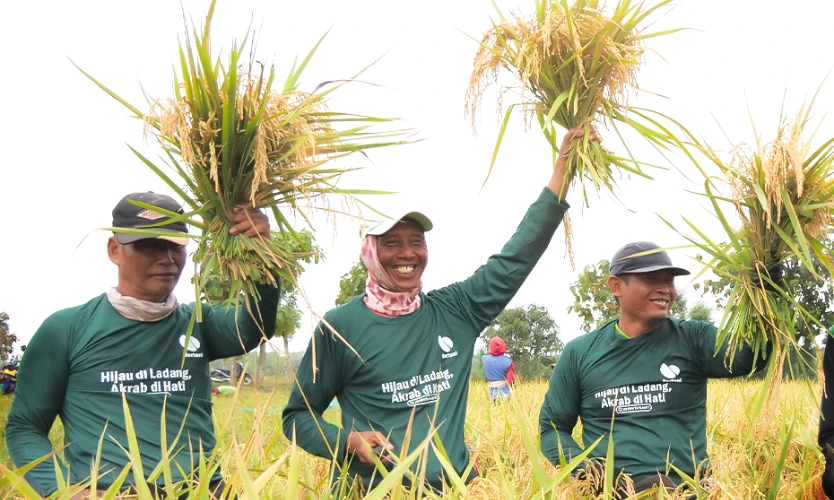
A sustainable agricultural system is one that utilizes both renewable and non-renewable resources efficiently. Sustainability in agriculture encompasses resource use, the quality and quantity of production, and environmental preservation. Sustainable agricultural production increasingly emphasizes the use of environmentally friendly biological products. Rice straw is one resource that can be utilized to improve soil fertility. Rice straw consists of the vegetative parts of the rice plant, including stems, leaves, and panicle stalks. As one of the largest sources of organic material generated in rice farming, rice straw represents a potentially valuable, affordable, and readily available source of soil organic matter.
Many farmers burn rice straw to speed up land preparation. However, burning straw reduces the soil’s organic matter content and contributes to air pollution. Rice straw also contains valuable nutrients that can benefit crops. Therefore, instead of burning it, farmers are encouraged to convert rice straw into organic fertilizer. Compost made from rice straw can improve soil fertility and support plant growth.
Materials Required
Rice straw
Urea fertilizer
Animal manure
0.5 kg of Trichoderma starter and Animal manure and the Trichoderma starter contain microorganisms that help accelerate the composting process.
NPK fertilizer
1 kg of lime
These chemical fertilizers serve as nutrient sources for the microorganisms present in the manure and Trichoderma starter.
Composting Procedure
Soak fresh rice straw overnight to maintain moisture.
Mix the active ingredients: urea fertilizer, SP-26 fertilizer, NPK fertilizer, lime, animal manure, and Trichoderma starter.
Chop or crush the rice straw.
Prepare a designated composting area or composting bed.
Place the first layer of chopped straw in the composting bed and moisten it evenly with water. Livestock manure may also be added at this stage.
Compact the straw by pressing or stepping on it.
Repeat the layering process until all the straw has been used.
The compost pile should be less than 1.5 meters high to facilitate turning during composting.
Once the pile is complete, cover it with plastic sheeting or additional straw.
Secure the cover tightly to protect the pile from direct rain and sunlight.
Successful composting is indicated by an increase in temperature, a reduction in volume or pile height, and a change in the color of the rice straw.
Maintain adequate moisture in the compost pile throughout the process.
The composting process typically takes 2–4 weeks, after which the compost is ready for use.
Monitoring the Composting Process
The composting process may reduce the pile volume by up to 50%. If, after two days, there is no noticeable shrinkage or temperature increase, the composting process is likely progressing too slowly. In such cases:
Open the plastic cover and inspect the compost pile.
If the straw appears dry, water the pile and turn it over.
If the pile appears overly wet and emits a strong odor, turn the pile and consider inserting bamboo poles into the pile to improve aeration and reduce excess moisture.
Characteristics of Mature Compose
Finished compost should have the following characteristics:
Dark brown to blackish-brown color
Compost temperature has returned to the ambient temperature present at the start of composting
Soft straw texture
Reduced volume compared to the original pile
No strong or unpleasant odor
References
Danapriatna, N. (2023). Biofertilizers and Rice Straw Waste for Sustainable Rice Farming. July 2023.
Sulastri, D., Billah, M. T., Kusnadi, D., Surialaga, J., Bogor, N., & Barat, J. (2021). Empowering Farmer Group Members Through the Utilization of Rice Straw as Bokashi Fertilizer in Purbaratu District, Tasikmalaya City. Jurnal InovasiPenelitian, 2(4), 1287–1298.