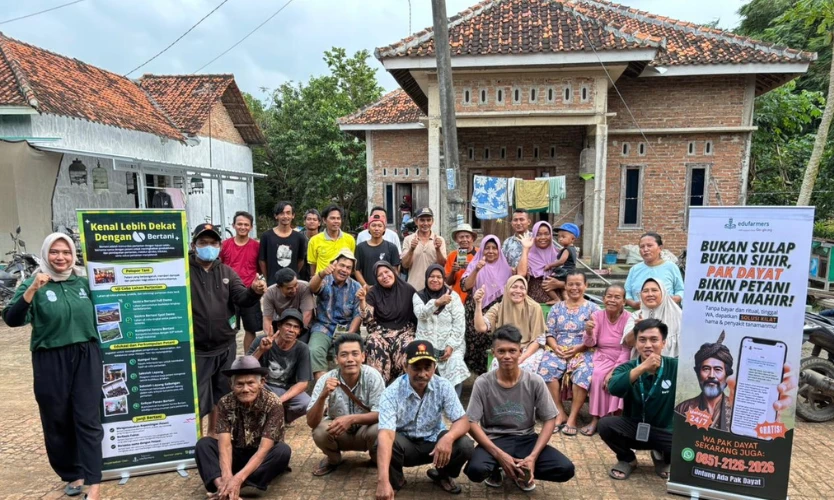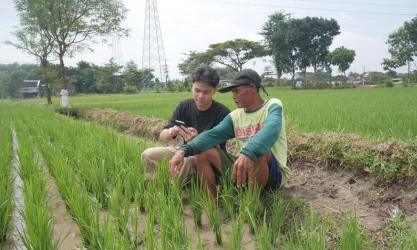
I sat on a porch in Gabuswetan, Indramayu, with a rice farmer everyone calls Pak Jenderal. His name is Sudirman — the same name as Jenderal Sudirman, one of Indonesia’s most famous generals — so the title stuck, and now nobody uses anything else.
We were talking about the AI agronomist our team built — Pak Dayat, which runs on WhatsApp — and I asked him how he’d used it to increase his harvest.
His answer was interesting, because it was close to how I use AI in the office every day. He interrogates it — keeps pushing until he gets to the answer he needs.
“Sayananyatuh, Pak Dayat, ini untuk meningkatkanhasilbobot harus pengaplikasianapa aja. Cuman saya juga bilangsaya punya 3 produkini, bagaimanameningkatkanhasilpanensaya.”
“I asked: what do I need to apply to increase yield weight? But I also said — I already have these three products. What can I do to maximise my harvest?”
He never asks what products to buy. Every so often he sends photos of his paddies when Pak Dayat asks how his crop is doing. He describes what he has already done and asks what more he can do with what is already sitting in his shed — asking the AI to work within the constraint and the context that he has.
The way he interacts and prompts gives him a good experience, and the ability to get the most out of the agronomist AI we created, Pak Dayat. His prompt has context, a goal, and a boundary condition. Any of us who work with these tools daily would recognise it immediately.
And it wasn’t only about making the most of what he already had. When he couldn’t afford the regular fertiliser the standard recommendation called for, he asked Pak Dayat what his rice actually needed.
The answer came back: potassium, phosphate, and nitrate — specifically nitrate, not nitrogen.
Armed with three chemical requirements instead of one product name, he went looking for something cheaper. He landed on liquid bottled nutrients, for reasons he explained with the clarity of someone who has thought about it a lot:
"Di botolnyakanadaketeranganinimengandungini, ini, ini. Jadi, oh inimungkin sama — bahkanadatambahanini. Di pupuk NPK tidakadaininya, di sini mahada.”
“The bottle lists what’s in it. So — oh, this might be the same, and it even has an extra element. The NPK doesn’t have this one, but this does.”
He bought sprayable nutrients because the label let him verify the chemistry himself, one bottle covered several applications, and it turned out to be more complete than the granular product he couldn’t afford anyway.
The extra spend was about Rp 500,000. The result was three additional quintals — on a plot where his harvest went from 17 quintals to over 20.
This was a clear case of a farmer who has successfully used AI to reverse-engineer a solution to a budget constraint.
Same village. Same tool. Different outcome.
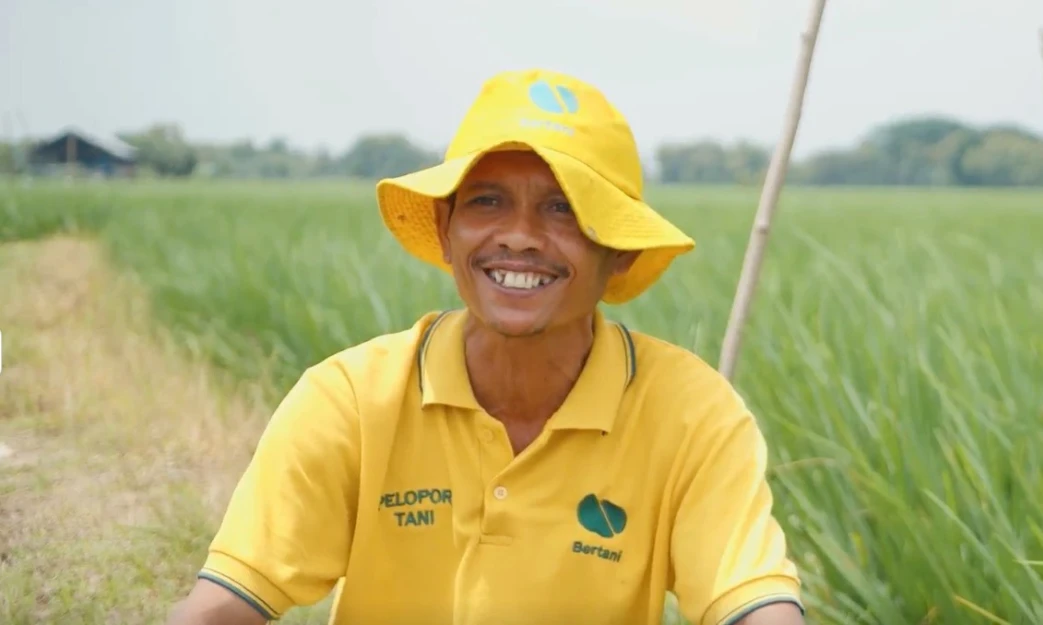
A few kilometres away we met Kang Ito, one of our pioneer farmers, also a Pak Dayat user, also for over a year.
He has never once used the photo diagnosis feature. Not because he objects to it — because he isn’t sure how to take the picture properly, so he has never tried.
He did learn something valuable, though, and he learned it by accident. He had been over-applying products. For years, probably. Nobody had ever told him otherwise, because as he put it: “kalaupetanikan gak ngertilahmasalahdosisnya” — farmers just don’t know about dosage.
But knowing and acting are different things. When Pak Dayat recommends a smaller dose than he’s used to, he described the reaction honestly:
"Dalamhati petani kannolak. Kokdosisnyakecil? Kayakjadiragu.”
“In the farmer’s heart, there’s a refusal. Why is the dose so small? You start to doubt it.”
And when the AI recommended a cheaper product with an identical active ingredient? He kept using the expensive one — “karenaudah punya” — because he already had it.
Two farmers. One tool. One is running his own nutrient trials against a chemical spec. The other is unsure how to hold his phone to take a picture of his crops.
Here’s the detail I keep returning to, while reflecting on what’s next on our efforts to disseminate Pak Dayat. While we have pioneer farmers (influential farmers), field facilitators, and advertisements promoting our agronomic AI, farmers’ experiences with Pak Dayat can differ widely. As Pak Jenderal shared:
“Udah, kansayasebarnomormah. Cuman kadang-kadangmungkincaranya juga — nanyanyakurangjelas. Jadi kadang-kadang, iniapa yang ditanyakan, apa yang dijawab.”
“I’ve spread the number around. But maybe it’s how they do it — they don’t ask clearly. So sometimes what gets asked and what gets answered don’t match.”
He gave them the tool. The questions came out vague, the answers came back generic, and his friends didn’t get the same level of experience and satisfaction as he did.
The part we haven’t solved
We have spent a great deal of our energy on reach — as of 29 July, we have almost 40,000 Pak Dayat users in Indonesia. Based on my time sitting on these farmers’ porches, we thought about how to maximise a farmer’s experience when they first try Pak Dayat, particularly as we advertise at scale. One short solution I thought of was producing static and video ads that show how to photograph a diseased plant and how to give AI enough context to get specific answers.
But here’s the tension, and I’d rather put it on the table than pretend it isn’t there.
Teaching farmers to use AI well makes AI potentially more expensive to run for a social program. A detailed question — one that carries background, context, examples and constraints — costs more input tokens than a simple one, and the same is true of the output. Because AI API pricing is calculated per token, more text, more complex and reasoned Q&A is substantially more expensive. The counterweight is that one well-specified question can replace six vague ones — and it keeps the farmer who would otherwise get a generic answer and never come back.
And the teaching itself isn’t only a token cost. Doing it well means going offline — a facilitator sitting beside a farmer through the first few conversations, pioneer farmers showing neighbours how they ask, a demonstration in the village rather than a video watched alone. That human layer costs more than the tokens. It is also, on the evidence of these two porches, what separates Pak Jenderal from Kang Ito. Which suggests the AI didn’t remove the extension worker so much as change the job: from delivering the recommendation to teaching a farmer how to ask for one.
I can’t help thinking about the trade-off. The better we get at this, the more each farmer costs us to serve. A tool used shallowly across 40,000 people is cheaper to run than a tool used deeply by a fraction of them. That sits awkwardly with how the sector talks about scale, where reach is the headline metric and cost per beneficiary is expected to fall over time.
I don’t think that means we shouldn’t do it. Pak Jenderal’s Rp 500,000 became three quintals. A farmer who stops buying three products with the same active ingredient saves more in one season than the marginal cost of teaching him to ask properly. The potential return is almost certainly there.
It is still a real constraint, and it belongs in the conversation early rather than arriving as a surprise on a future budget line — particularly if inference costs rise rather than fall as these models get more capable.
The reflection this leaves me with
Philanthropic and grant funding for AI in development has concentrated — understandably, and successfully — on building things. Models, platforms, pilots. Pak Dayat exists because of that support, and we’re grateful for it.
Reach follows readily too — more users, more districts, more coverage. Both were the right investments, and we made them. We report almost 40,000 users, and that is real progress. What a year of use is teaching us is that adoption and fluency are not the same thing — and that the gap between a tool’s best and median user is wide for any AI product, in Jakarta offices as much as in Indramayu paddies. In our case, most of that growth came from advertising, which means most of those farmers arrived at a blank chat box with nobody sitting beside them. That is still progress. Closing the distance between those farmers and Pak Jenderal is the next piece of work, and after a year in the field it is the piece we understand best. That work is hard to name in a proposal. It isn’t building, and it isn’t scaling. It’s going back to something that already works and reshaping it, because you’ve learned something new.
So the questions I’d put to anyone thinking about this:
What’s the right measure of success when the gap between your best and your median user is this wide?
How do you make the case for investing in depth when the reach numbers already read as success?
Are there ways to use tokens more efficiently while maintaining the quality and relevance of the recommendations farmers receive?
And if the human layer is what makes the tool work, how do we fund the people rather than the platform?